Benefits Your K-12 Foodservice
Reliable foodservice starts behind the scenes, with consistent food well performance supported by the right…

Are you carefully evaluating R-290 (propane) and R-454C food well systems? It’s a decision that shouldn’t be overlooked.
While both refrigerants meet low-GWP (Global Warming Potential) goals, they operate very differently in K-12 foodservice, affecting maintenance downtime, under-counter space, serving line flexibility and day-to-day efficiency.
Before your selection, here’s what to know.
One of the clearest differences between these refrigerants is how systems are configured, especially on a six-well serving line.
R-290
R-290 has a charge limit of 150 grams per circuit (the current industry limit for this product category), which means a 6-well line could require up to 6 individual compressors.
R-454C has a charge capacity of 2,330 grams per circuit, which means 3 compressor systems can cool up to 6 wells simultaneously.
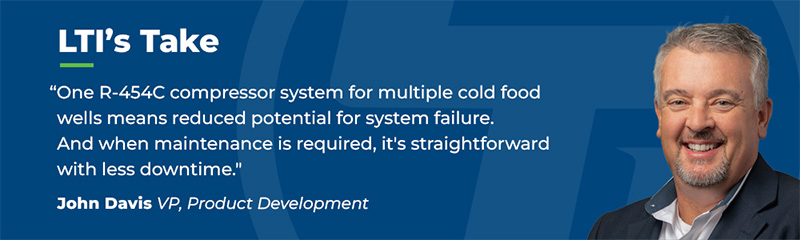
In a single convertible food well system, R-454C can support up to 6 cold and frozen food wells, while the hot food wells operate from a separate heat source. This gives staff more flexibility to switch between temperature zones for a diverse meal program or as menus change.
By comparison, R-290 systems are typically limited to one food well per compressor because of charge restrictions. Depending on how the R-290 food well compressors are configured in the line, staff may need to be more selective in their use of cold and frozen applications.
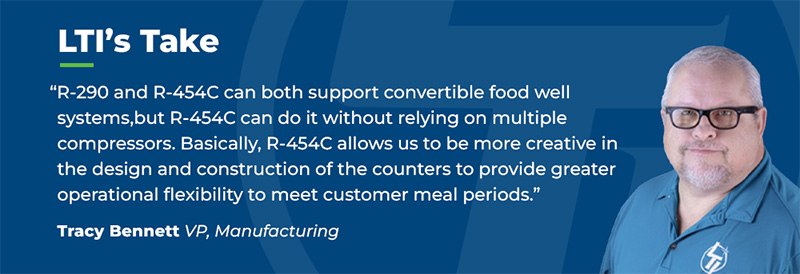
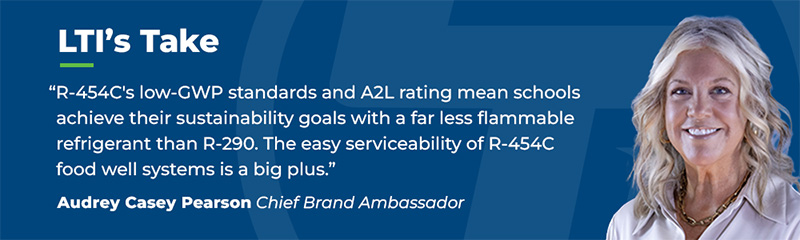
Because of its A2L classification, R-454C systems allow refrigerant to be reclaimed in place in accordance with applicable procedures, reducing the need to move equipment outdoors. That can help minimize disruption during meal prep or service windows.
Because R-290 is A3 classified, certain service procedures may require units to be relocated before refrigerant work begins. When multiple compressors support one serving line, that process can potentially become more time-intensive.
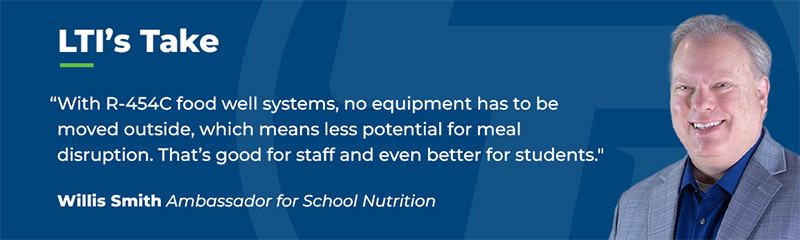
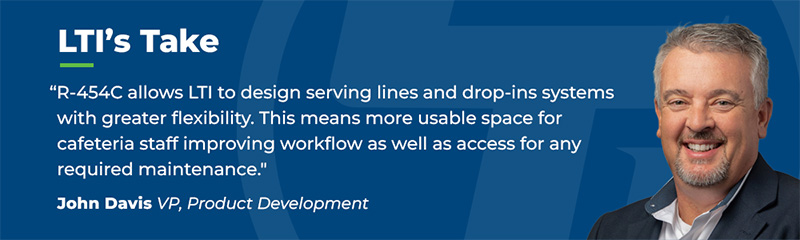
Using fewer compressors and fewer supporting components can significantly reduce under-counter congestion. That added space can improve workflow in several ways:
Yes. R-454C has a GWP of approximately 146, making it a low-GWP refrigerant option. R-290 also meets low-GWP goals with a GWP of approximately 3.
| Feature | R-290 | R-454C |
|---|---|---|
| ASHRAE Classification | A3 (highly flammable) | A2L (mildly flammable) |
| Charge Capacity | 150g per circuit (current industry limit for this product category) | 2,330g per circuit |
| Compressors for 6 Cold Wells | Up to 6 | 1 |
| Serviceability | Units need relocation into a well-ventilated area or outside of the building | In-place refrigerant reclaim |
| Under-Counter Footprint | Larger | Smaller |
| Multi-Well Flexibility | Limited | Higher |
Download our educational resource, A Guide to Modern Food Wells for K-12 Foodservice.
You can also visit our R-454C educational page.
Whether you’re considering food wells systems or serving counters, we have foodservice experts who can offer guidance to help you determine the right equipment for your cafeteria. Questions? Get in touch with our knowledgeable team.


All rights reserved © 2026 LTI, Inc. | Privacy Policy | Cookie Policy